Most survival skills can be practised for free or nearly free. That sounds like a marketing line, but it holds up once you look at what the skills actually are. Fire lighting, shelter building, water collection, navigation, first aid — none of them require a four-hundred-pound course or a rucksack full of branded gear. What they require is repetition, a bit of discomfort, and the willingness to fail in your back garden before you fail somewhere that matters. This comparison ranks the low-cost routes to each core skill, flags the traps where beginners waste money, and ends with a priority list for your first month of practice.
What you can learn for nothing, and what that actually covers
Start with the honest truth: the free tier of survival training is bigger than most people expect. Your local library likely holds a shelf of practical bushcraft and wilderness medicine books, and second-hand copies of the classic manuals turn up at charity shops for a pound or two. YouTube has thousands of hours of instruction, some of it excellent, some of it dangerous nonsense — the skill is telling them apart, which mostly means checking whether the presenter shows the failure modes as well as the success.
Free practice spaces matter just as much as free information. A back garden, an allotment, a quiet corner of a park where fires are permitted, or even a balcony with a metal tray will do for the basics. You can practise knot tying on a length of cheap paracord while watching television. You can practise shelter building with a tarpaulin and two trees. You can practise water filtering with a cloth, a plastic bottle, and some sand and gravel from a builder’s merchant skip. None of that costs anything beyond what you already own.
The free tier covers fire by friction and by ferro rod, basic tarp shelters, improvised water pre-filtration, map and compass work, plant identification at a beginner level, and the kind of first aid that stops bleeding and keeps an airway open. What it does not cover well is feedback. Nobody free is watching your bow drill technique and telling you your spindle is too thick. That gap is where a small amount of money genuinely helps.
Cheap options that beat expensive gear for beginners
Here is where most beginners lose money. They buy a knife before they know how to sharpen one. They buy a survival kit in a tin before they know what each item does. They book a weekend course before they have spent a single night outside. The cheap alternatives are almost always better for the first six months.
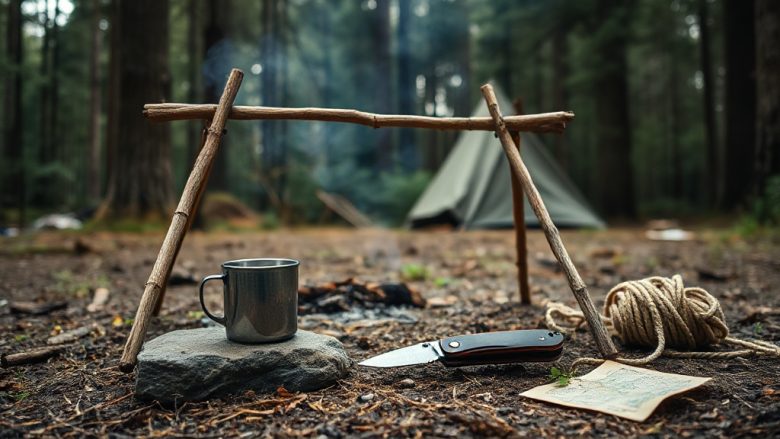
A basic mora-style fixed-blade knife costs around fifteen pounds and will outperform a fifty-pound folding tactical knife for carving and batoning. A ferrocerium rod costs a few pounds and teaches you more about tinder than a box of matches ever will. A simple blue foam sleeping mat and a cheap tarp will get you through a night in a garden or a campsite far better than an expensive bivvy bag you have not tested. A second-hand Ordnance Survey map of your local area, bought for a couple of pounds, is a better navigation teacher than any app because it forces you to think in contours and grid references.
Cheap courses exist too, and they are usually run by local councils, wildlife trusts, or community woodland groups rather than commercial survival schools. A two-hour foraging walk or a basic fire-lighting workshop might cost five to fifteen pounds and gives you the one thing free content cannot: a person correcting your mistakes in real time. Look for these in autumn and spring when groups run family events. They are not marketed as survival training, which is exactly why they are affordable.
One short list is worth keeping in mind when you are tempted to spend. Buy in this order: a fixed-blade knife, a ferro rod, a tarp, a water container, and a first aid kit you assembled yourself. Skip everything else until you have used those five items at least twenty times each. The gear you do not own cannot fail you, and the money you did not spend can go toward a course later when you know what you need to learn.
Where paying actually makes sense, and where it does not
Some things are worth paying for, and it is usually not the gear. It is the feedback, the access, and the safety net.
Pay for a recognised first aid course. This is the single best use of a tight budget. A basic emergency first aid certificate costs somewhere between forty and eighty pounds and covers the skills that matter most in a real incident: bleeding control, CPR, recovery position, and recognising shock. You cannot learn these properly from a video because you need to practise on a manikin with someone checking your hand placement and compression depth. This is the one area where free substitutes are genuinely inadequate.
Pay for access to land where you can legally light fires and camp. Wild camping is restricted in most of the UK, and practising shelter and fire skills in a place where you are not allowed is a fast route to a fine and a bad reputation for everyone who enjoys the outdoors. A night on a cheap campsite costs ten to fifteen pounds and gives you a legal, safe place to test your setup. Do that three or four times before you consider anything wilder.
Do not pay for branded survival kits. Do not pay for online courses that promise certification in bushcraft, because no recognised body issues one. Do not pay for a knife you cannot legally carry in public. Do not pay for a weekend course until you have practised the basics yourself and know which specific skill you are stuck on. The best money you spend on survival skills is usually the money you spend on being corrected, not the money you spend on being equipped.
A first-month priority list for a very small budget
If you have almost nothing to spend, here is a realistic order of operations for your first four weeks. Week one: learn three knots — the bowline, the taut-line hitch, and the sheet bend — using any cord you already own. Practise them until you can tie them without looking. Week two: light twenty fires with matches or a lighter in a safe, legal place, then try ten with a ferro rod. Focus on tinder preparation, not flame. Week three: build three shelters in your garden or a willing friend’s garden using a tarp and cord, and sleep in one of them for a night. Week four: walk a local route using only a paper map and compass, and separately, assemble a small first aid kit from a supermarket and learn what each item is for.
Total spend for that month: a ferro rod, a tarp, a cheap map, and first aid supplies. Call it thirty to forty pounds if you buy nothing second-hand. That is less than a single commercial survival course, and by the end of it you will know more about your own strengths and gaps than any weekend workshop could teach you.
The pattern to remember is simple. Free gets you information and repetition. Cheap gets you the few tools that make repetition possible. Paid gets you correction and legal access. Spend in that order, and survival skills on a tight budget stop feeling like a compromise. They become the version that actually sticks, because you built it yourself, one small failure at a time.